
📈 Chasing Alpha Weekly
Google crushed earnings. The stock sold off. Here's why that matters for everything this week.

📈 Chasing Alpha Weekly — July 26
$SPY broke the 55-day. Google crushed earnings and the stock sold off anyway. There are two specific mechanisms driving this carnage — and neither of them is what most people think.
Chasing Alpha Weekly drops every Sunday. I break down the macro signals, sector rotations, and specific trade setups I’m watching for the week ahead. If you’re new here — subscribe below so you don’t miss it.
Google blew out earnings. The stock sold off immediately.
$SPY broke its 55-day. $QQQ broke its 55-day. Semis keep losing key levels. And every weekend the same question: is this the bottom?
Here’s the answer: it depends entirely on what $MSFT, $META, and $AMZN say on their conference calls this week. And I mean specifically one number — capex guidance.
But before we get there, you need to understand the two mechanisms that are actually driving this selloff. Because if you understand them, the entire picture becomes clear. And if you don’t, you’re going to keep getting run over trying to catch a bottom that isn’t ready yet.
Let’s get into it.
What Happened Last Week
↑ Winners
$SOXX did not hit a new low while $QQQ did — divergence worth watching closely
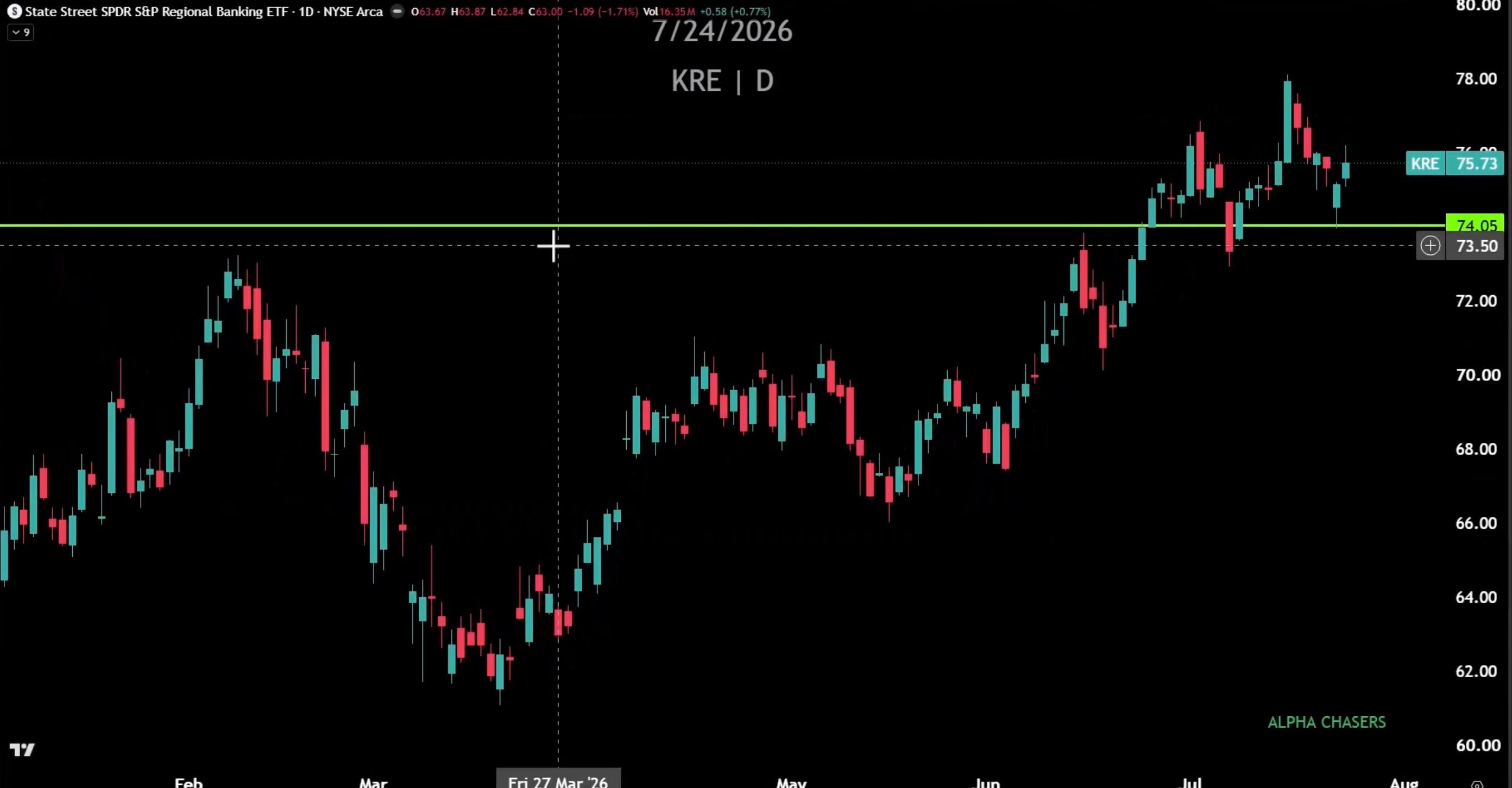
$XLF and $KRE starting to lift — financials showing early signs of life
Refiners and crude-related names continuing to work as oil pushes higher
→ Watch
$MSFT, $META, $AMZN all reporting this week — capex guidance is the only number that matters
Fed meeting this week — any rate hike sends tech into another leg lower
COR1M still elevated — needs to get back above 8 before the inflow/outflow problem resolves
↓ Laggards
$SPY and $QQQ both broke their 55-day — institutions not stepping in on Fridays
$GOOGL crushed earnings, guided capex higher, stock sold off immediately
10-year yield up 8% in less than a month — back to multi-year highs
$MU, $LRCX, $KAC all losing their 55-days on good news — the macro is overriding fundamentals
The index is telling you one story. The two mechanisms underneath it are telling you a much more important one.
The Two Mechanisms Nobody Is Connecting
Let me walk through both of these carefully because I think most people are looking at individual stocks and headlines when the real story is structural.
Mechanism 1: The Inflow/Outflow Problem
Every major hedge fund owns roughly the same names. Nvidia. Amazon. Google. Microsoft. The top semiconductor names. They all piled in together during the AI boom — and now they’re all underperforming the $SPY simultaneously.
Here is the math that matters: $SPY is down roughly 2.7%. The top 20 hedge fund holdings are down roughly 10%. That is an enormous gap. And because these funds are judged against their benchmark, they are not just losing money — they are losing to an index fund. That is career risk.
So what do they do? They start getting out. And because they all own the same names, they all get out of the same names at the same time.
If you owned the NASDAQ versus the $SPY from June 30th through now, you have already given up roughly 6% in relative underperformance in a single month. That is not a blip. That is a crowded trade unwinding.
This is not about earnings. It is not about fundamentals. It is about too many people in the same names getting out at the same time. That is mechanism one.
How does it end? It ends when the $SPY starts falling alongside everything else and cash comes off the sidelines. Not before.
Mechanism 2: Negative Free Cash Flow Meets Rising Yields
This is the one that matters more. And this is the one that has historical precedent.
Google just went free cash flow negative for the first time in roughly 10 years. They guided to keep spending. The minute that number crossed the tape on the conference call, the stock went straight down.
At the same time, the 10-year yield is up 8% in less than a month — back to multi-year highs. Crude oil is driving this. Two-thirds of GDP is connected to crude one way or another and when crude pushes higher, inflation expectations rise, yields rise, and the cost to borrow for every company carrying debt goes up immediately.
Here is where it gets important: every hyperscaler is now carrying enormous debt loads to fund their AI buildout. Google. Meta. Microsoft. Amazon. Oracle. They are all borrowing to spend. And as yields rise, the interest payments on that debt become more expensive — which makes it harder to service, which raises their CDS spreads, which raises the cost of new borrowing, which makes the next bond issuance more expensive.
This is exactly the mechanism that ended dot-com. Not the lack of earnings — though that was catastrophic. It was the moment that the market decided it no longer wanted to fund the secondaries and bond issuances. When people stopped showing up to buy the debt, the whole thing unwound.
The difference now is these companies have real earnings and real cash flow. They can stop spending at any time and become cash cows again. But until they do, every new bond issuance and secondary dilutes the stock and raises the cost of capital. That is mechanism two.
Enjoying this so far? Chasing Alpha Weekly goes out every Sunday.
Subscribe below so you never miss a week.
Why Google’s Earnings Reaction Tells You Everything
Google absolutely crushed. They were supposed to report around $260 in EPS and dramatically exceeded it. Revenue was massive. AWS and cloud equivalents growing fast.
And the stock sold off immediately.
Why? Because on the conference call, they said capex is going higher. Not flat. Higher. And they said — almost verbatim — “we are just beginning.”
That single phrase sent the stock down hard. Because pension funds, life insurance companies, and institutional investors who need free cash flow to justify ownership heard it and immediately started selling. They do not want to own a company that is voluntarily going free cash flow negative with no end date in sight.
This is not a Google-specific problem. This is the template for every hyperscaler reporting this week.
Watch the conference calls. Watch the capex guidance.
Watch how the stock reacts in the first 30 minutes after.
If $MSFT, $META, or $AMZN cut capex or hold it flat — the stocks rip, CDS spreads drop, cost to borrow drops, and the mechanism starts to reverse. If they raise capex — more selling, more negative free cash flow pressure, more yield sensitivity.
After what Google just did, the probability of a capex cut is slim. But it is the number to watch.
The 5 Setups I’m Watching This Week
📌 $MSFT / $META / $AMZN — Conference Calls Are Everything
Capex guidance is the single most important number across all three reports
If any of them cut or hold flat → stock rips, CDS spreads compress, cost to borrow drops
After Google’s reaction, market is pricing in more increases — any surprise to the downside on spend is explosive to the upside
Do not focus on EPS. Do not focus on revenue. Focus on capex guidance and the language around whether they see it accelerating. That one number determines the next 3 months for tech.
📌 $SOXX — The One Divergence Worth Watching
$SOXX did not hit a new low while $QQQ did — this divergence is meaningful
Watch the 50% line on $SOXX — holding it is the first sign of a real bottom forming
Same setup as April 2025 — semis can bottom before the NASDAQ
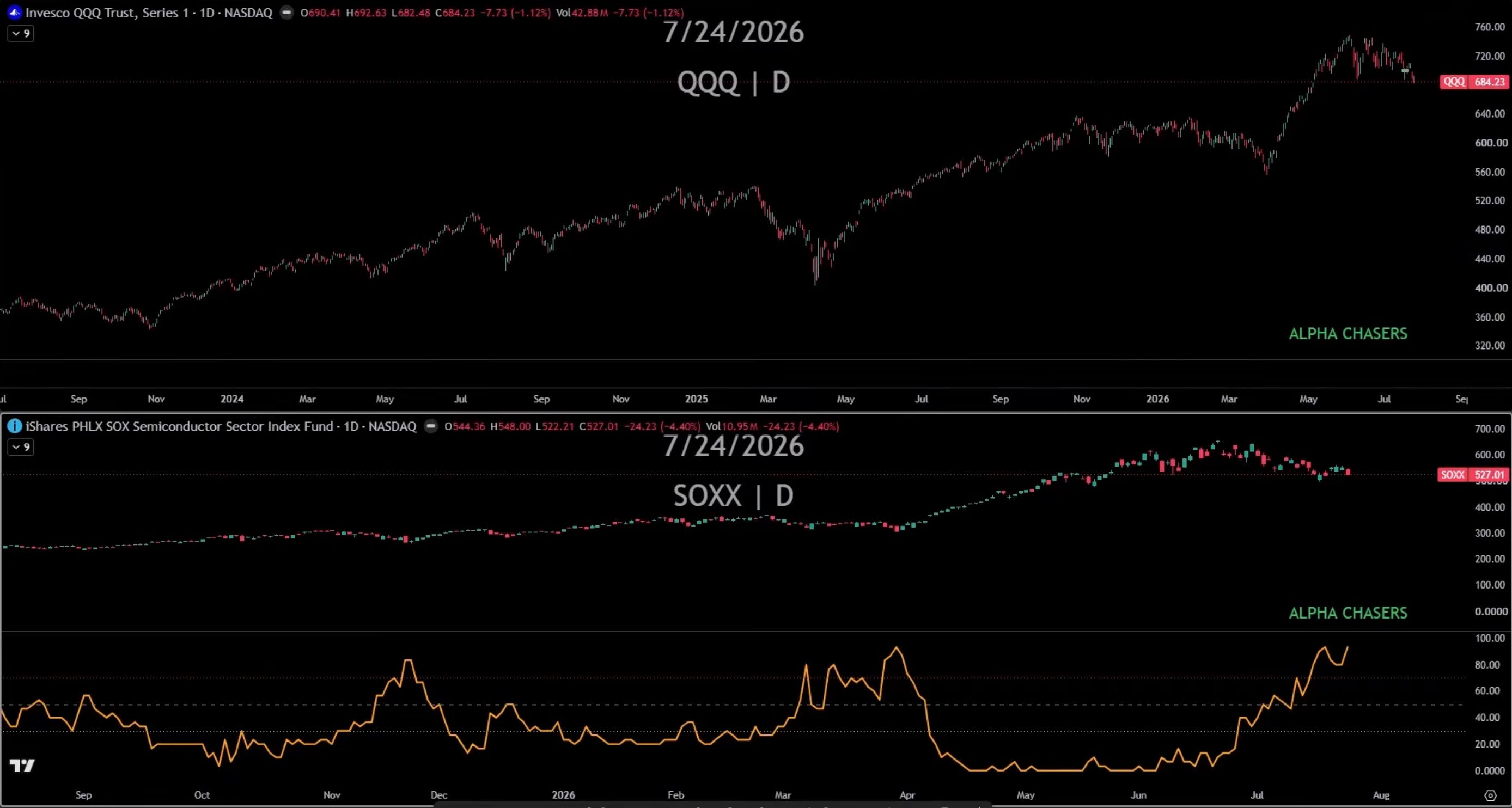
Semis bottomed before the broader NASDAQ in 2025 and led the recovery. The setup is similar now. If $SOXX holds here and starts to build, that is your first signal that the worst is behind us. If it breaks to new lows, we have more work to do.
📌 $MU / $SNDK — Good News Not Working Is a Warning Sign
$LRCX and $KAC lost their 55-days on good news — macro overriding fundamentals
Intel announced $20B in buildout — stock dropped because the market asked “where does that $20B come from?”
DRAM pricing still the only true leading indicator — watch it daily
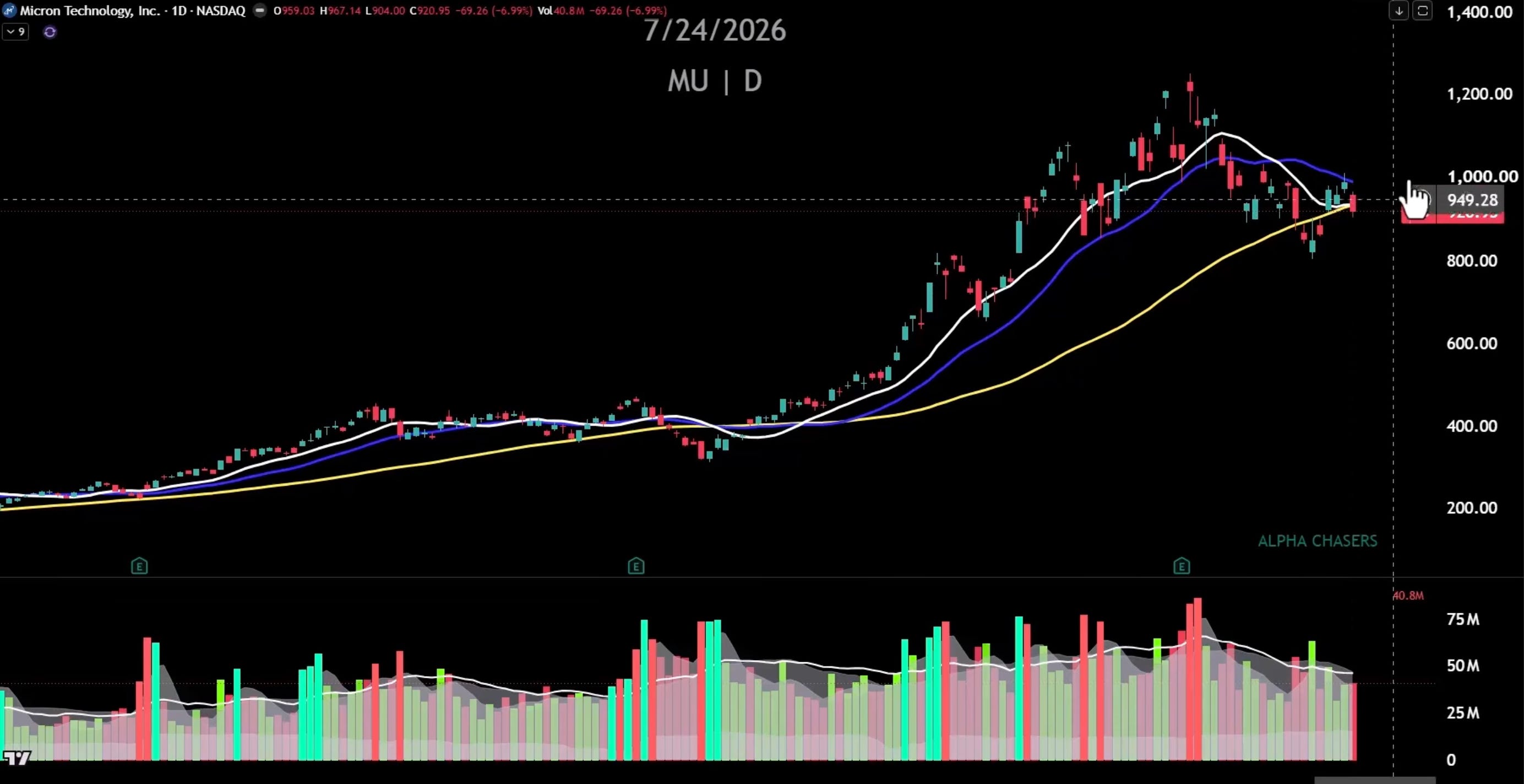
When good news stops working, the macro is in charge. Do not fight that environment with swing trades. Wait for the macro to stabilize — specifically yields and capex guidance — before re-entering with size.
📌 The Fed Meeting — Rate Hike Risk Is Real
10-year yield up 8% in less than a month driven by crude oil and inflation expectations
If the Fed raises rates, tech takes another leg lower immediately
If they hold and signal cuts are coming — yields drop, cost to borrow drops, CDS spreads compress
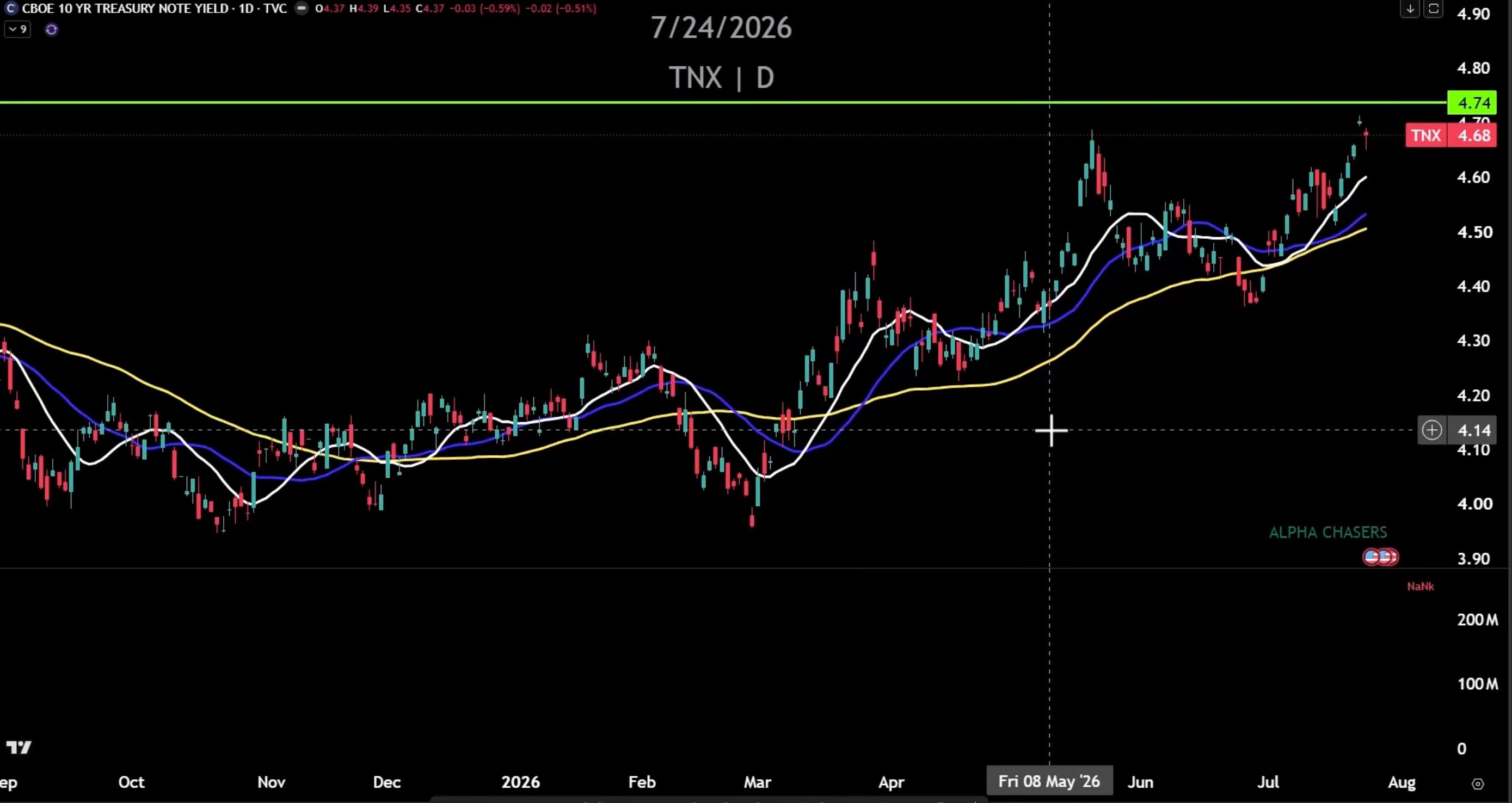
The Fed meeting this week is binary for tech. Watch the 10-year yield response in the minutes after the statement. That is your real-time signal on what institutions think just happened.
📌 $XLF / $KRE — The One Sector Starting to Work
Financials and regional banks both starting to lift
Rising yields are actually good for bank net interest margins
If yields stabilize here, financials could be one of the cleaner setups into year end
While tech is dealing with the two mechanisms above, financials benefit from higher rates on the NIM side. Not chasing this yet — but watching closely for a clean entry as the broader market stabilizes.
What I’m Watching This Week
$MSFT / $META / $AMZN Conference Calls
Listen for capex guidance. Listen for language around acceleration or deceleration. Watch how the stock reacts in the first 30 minutes. That reaction is the market telling you whether it believes the story.
Fed Meeting
Rate hike = another leg lower in tech. Rate hold with dovish language = relief rally. Watch the 10-year yield response, not the headline.
COR1M
Needs to get back above 8 before the inflow/outflow problem starts to resolve. Still elevated. Not there yet.
DRAM Pricing
Still the only leading indicator that actually matters for the semiconductor thesis. Pricing has not broken down yet. When it does, the fundamental case changes. Until then, this is a technical and macro correction, not a fundamental one.
The Bottom Line
Two mechanisms. One is structural — hedge funds all in the same names unwinding simultaneously because they’re underperforming the index. Two is macro — negative free cash flow meeting rising yields on companies carrying enormous debt loads.
Neither of these ends with a tweet. Neither ends because the stock looks cheap on a chart. They end when capex gets cut, when yields drop, or when the $SPY falls enough to flush the crowded trade.
This week you get three hyperscaler conference calls and a Fed meeting. The capex numbers on those calls will tell you more about the next 3 months than anything else happening in the market. Listen to them. Watch how the stocks react. Trade what is actually happening — not what you think should happen.
The full breakdown — including the CDS spread analysis, the dot-com parallel deep dive, and exactly what to listen for on the $MSFT, $META, and $AMZN calls — is on YouTube now.
Plus the earnings were fake mark ups of "Private investments" would make Enron and WorldCom blush.